
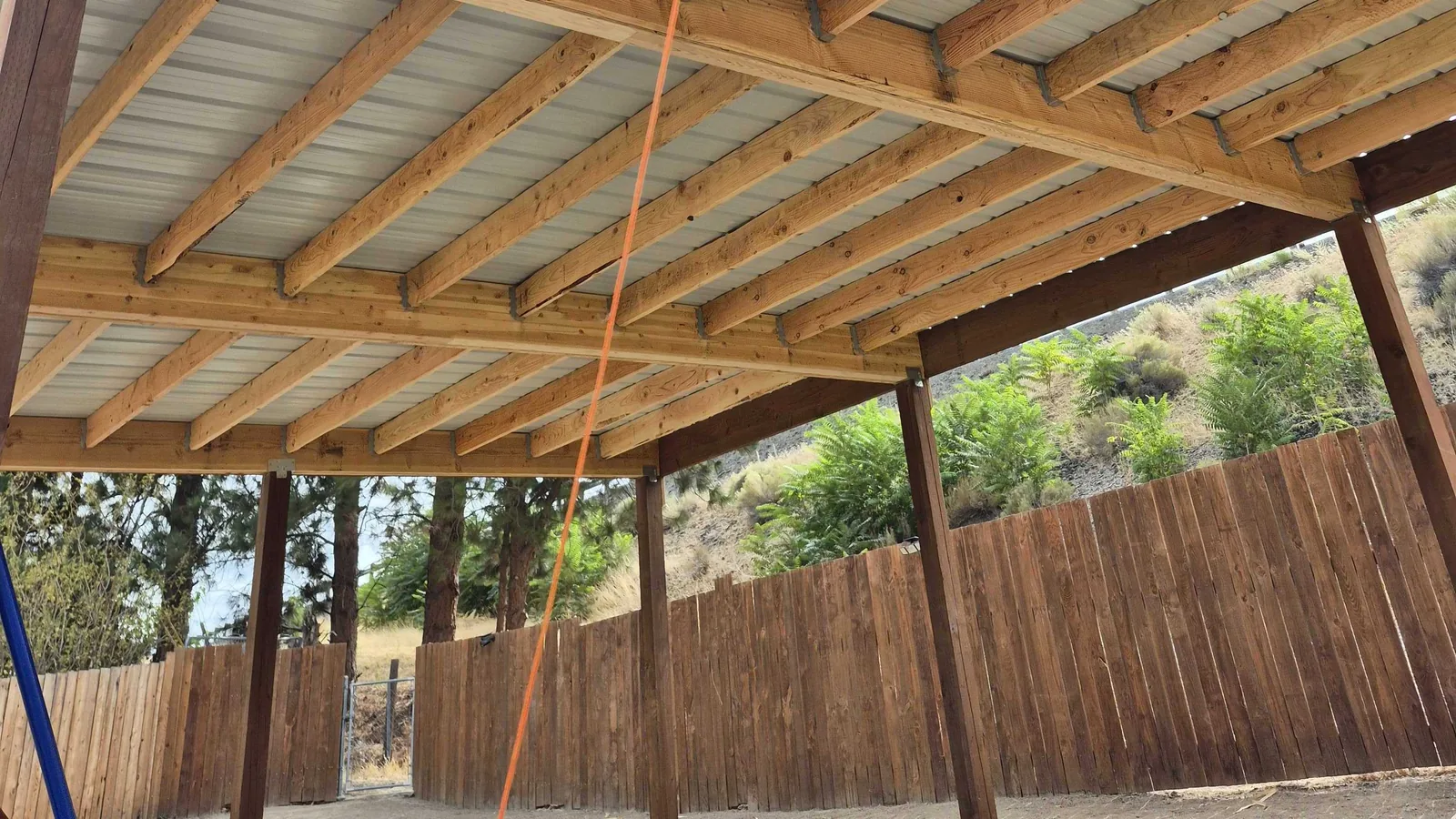
How Much Does a Shop Pad Cost in the Yakima Valley?
A compacted gravel pad for a shop runs about $1 to $3 per square foot in materials. That is a national cost guide’s gravel figure. A concrete slab on grade runs about $4 to $12 per square foot installed, by the same publisher’s 2026 guide. For a 30 by 40 foot shop, that puts the slab alone at roughly $4,800 to $14,400. The pad work, the permit and any thickened edges come on top. These are national market numbers, not our price list, and they move with the price of concrete and trucking.
The pad is the part most people forget to price. The dirt work comes first: stripping, cut and fill, compaction and the gravel base. The slab sits on it, and the shop sits on the slab. Our shop and building pad work covers the pad and the slab. The quote is written after we look at the site.
What does a shop pad cost per square foot?
The published ranges below come from national cost guides. The 2022 pages predate the last few years of concrete and fuel price moves. Read them as a floor, not a quote.
| Item | Published range | Source and date |
|---|---|---|
| Base gravel, delivered | $15 to $30 per ton, about $1 to $3 per square foot | national cost guide, 2022 |
| Gravel delivered and spread | $50 to $100 per cubic yard, in 3 to 4 inch layers | national cost guide, 2022 |
| Concrete floor poured in a pole building | $2 to $4 per square foot | national cost guide, 2022 |
| Standard slab foundation | $4 to $6 per square foot | national cost guide, 2022 |
| Slab on grade foundation | $4 to $12 per square foot | national cost guide, February 2026 |
| Monolithic slab with built-in footings | $4 to $16 per square foot | national cost guide, February 2026 |
| Frost-proof slab | adds $8 to $12 per square foot | national cost guide, 2022 |
| Plans, permits and site prep for a 1,600 square foot pole barn | $7,500 to $15,000 | national cost guide, 2022 |
Two more figures from the 2026 guide explain the spread. Labor is 40 to 60 percent of a foundation’s cost, so a tight site that slows the crew costs more. Foundation permits can run up to $2,300 nationally, and every town in the valley sets its own fee.
How much concrete does a shop slab take?
The arithmetic is simple and it drives the bill. One hundred square feet at 4 inches thick takes 1.23 cubic yards of concrete. At 6 inches it takes 1.85 cubic yards, half again as much. A 30 by 40 foot shop is 1,200 square feet. That is about 14.8 cubic yards at 4 inches and 22.2 at 6 inches.
The minimum cities check comes from the residential code. A slab must be at least 3.5 inches thick over a 4 inch graded gravel base. Kennewick’s slab checklist adds the fill limits. No more than 8 inches of earth fill may sit under the slab. Sand or gravel fill is capped at 24 inches. A thicker slab for a shop that parks a loader or a truck is a design choice. It goes on the plans, not in the code minimum.
What drives the price of a shop pad in the Yakima Valley?
- Size and shape. A long narrow pad takes more edge forming than a square one of the same area.
- Cut and fill. A flat lot in Sunnyside’s Warden silt loam digs and compacts easily. Benches above the valley floor can hit hardpan, and the low ground west of Sunnyside holds a seasonal water table. A sloped lot under Red Mountain or above Selah takes more cut.
- Stripping. The concrete trade association’s guidance is plain. All topsoil and soft spots come out, and the slab sits on compacted soil or granular fill. That is site preparation, and it is where a bad pad goes wrong.
- Thickness and reinforcement. Six inches of concrete costs half again as much as four, before the steel.
- Footings and edges. Thickened edges or footings to the 24 inch frost line, where the plans call for them, add concrete and forming.
- Joints. The association’s rule is 24 to 36 times the slab thickness. That is about 10 feet apart on a 4 inch slab, and never more than 15 feet. Joints left out are the first reason slabs crack.
- A vapor retarder. A heated or finished shop floor wants at least 10 mils of plastic under the slab.
- Access and hauling. Gravel costs by the ton and by the mile, and a pump truck costs more than a chute.
- Season. Around Sunnyside the ground is frozen on about 124 nights a year, and July highs sit near 88. A winter pour needs protection and a summer pour needs water and shade. Spring and fall are the easy seasons for grading and compaction.
Do you need a permit for a shop pad?
The shop needs a building permit in every town we read. That runs from Sunnyside and Yakima to the Tri-Cities and the small towns between them. The pad goes on the shop’s plans and gets inspected with it. Unincorporated Yakima County never exempts a structure used for tractor or farm equipment storage, a carport or a garage. A farm shop is not a loophole. The City of Yakima sets its permit fees from the building valuation table the code council publishes each year.
Flatwork on its own is looser. Pasco exempts concrete slabs and patios under 30 inches above ground. Richland exempts poured patios, but a covering over one requires a permit there. The permit office for your parcel answers the question for your lot, and we point you to it. On every lot, a locate request goes to 811 two to 10 business days before digging.
Gravel pad or concrete slab?
A gravel pad is enough for a pole building with a dirt or gravel floor. It also serves equipment storage or a camper pad. It costs less, and the floor can be poured later once the building is up. A concrete slab is the answer for a finished shop or a garage floor. Anything with a floor drain, heat or a lift wants one. A monolithic slab with its footings built in runs $4 to $16 per square foot in the 2026 guide. It carries the building’s posts on the same pour.
The building itself is a separate line. Post-frame shops, carports and covered storage are the building side of our work. The pad and the building are quoted together when you want them that way.
What to ask before you sign for a pad
- How thick is the slab, and how thick is the gravel base under it?
- Where do the control joints go, and how far apart?
- Is the pad cut to firm native soil, or built up with compacted fill, and in what lifts?
- Is there a vapor retarder under a floor that will be heated or finished?
- What happens if a hard frost is forecast the week of the pour?
- Who stakes the corners and the elevations, and does the city want a soils report? Sunnyside requires one for commercial permits.
Ready for a number on your own pad?
National ranges tell you the shape of the cost. Your lot sets the real one: the cut, the fill, the access and the slab you want. We look at the site, measure it, and put the quote in writing. Call or text (509) 439-2533, or read how a pad is built from the ground up before you call.